Peter’s account of Cornelius and the Spirit in Acts 11
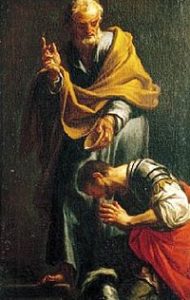 Once again the Dominicus lectionary points us towards the reading from Acts as an important point of focus in the post-Easter narrative. The reading 'which must be used as either the outset or the second reading' is Acts xi.one–18, the concluding episode in the 'Petrine narrative' which began with Peter healing Aeneas and raising Tabitha at the terminate of chapter 9, which was last week's reading. After this week'south reading, we run into the focus shift from Jerusalem to Antioch, which becomes a major center of the Christian community, sending Paul and Barnabas out on their 'missionary journeys'. Peter makes an appearance in chapter 12 when he is miraculously released from prison (as Paul is too in affiliate sixteen), and gets 1 mention at the Council of Jerusalem in Acts 15.7—and that is his last appearance in Acts.
The episode with Cornelius is pivotal to Luke'south narrative in Acts, marker the formal access of Gentiles every bit Gentiles into what was until now a Jewish renewal movement which hailed Jesus as the (unexpected) Jewish Messiah. This move has been adumbrated offset in the response of Samaritans to the practiced news, brought past Philip in Acts 8.4, and in Philip's further ministry building to the Ethiopian official ('eunuch') in Acts viii.26f. This man appears to have been a 'God fearer' since, though not Jewish, he has 'come to Jerusalem to worship' (Acts 8.27). Here, faith comes to those groups immediately adjacent to the Jewish nation, but the flood of the good news is nearly to flare-up even these banks. The importance of the Cornelius incident is shown by Luke's recounting information technology, and then recounting information technology again in Peter's first speech, and again at present. Luke appears to communicate the importance of events past including detail and repetition—and then we afterward hear several accounts of Paul's 'conversion' too, signalling the importance of that incident in the spreading of the good news virtually Jesus.
The comment in Acts 11.1 that the apostles and 'brothers' (believers) in Judea had heard about what happened is a classic device of Luke to link the previous episodes with what he now relates. Simply it also contains some of import detail. First, Cornelius has functioned (every bit have the Samaritans and the Ethiopian official) as a 'span' character; he is not a infidel, but belongs to a grouping that Luke has called 'God fearers'. To adapt Jesus' words in Marking 12.34, he is not far from the people of God—and yet he is clearly non yet counted a member. Withal respected he is, as far as the (Jewish) Jesus movement is concerned, he represented 'Gentiles' who have received the 'give-and-take of God'—a phrase sometimes denoting Jesus, sometimes the Scriptures, simply here, the message of the good news equally it has been proclaimed.
The same phrase has already been used by Luke in Acts 8.14 of the Samaritans, inviting usa to see the link and the parallel. For Luke'due south get-go readers, they volition recognise that Luke is describing the spread of the gospel in a way familiar to ancient historians, describing eventskata genos, by 'kind' meaning race or region. It is no blow that Luke is careful to specify locations, ethnic groups and problems of social status.
Then when Peter goes to Jerusalem, the news has preceded him. He is non, it appears, criticised by the apostles, only 'those of the circumcision', οἱ ἐκ περιτομῆς. The NIV is incorrect to translate this as 'circumcised believers', non least since all the believers in Jerusalem were circumcised! Rather this refers to those who were adamant about careful keeping of the law, and then the ESV is probably right to use the phrase 'those of the circumcision party', a grouping which Paul volition subsequently loudly clash with in his letter to the Galatians. The criticism is that Peter 'ate with them'—in social context (equally all through the New Testament) sharing food being a sign of partnership and fellowship with them—which is not actually mentioned in the previous accounts, just inferred.
In his defence force, Peter offers a forensic speech which dispenses with introductory comments and launches immediately into thenarratio, the story of what has happened, told from his own point of view, and so fitting in the meetings with Cornelius' messengers and household in the social club he experienced them—though, surprisingly, not mentioning Cornelius' name, perhaps because it is his status as a Gentile, rather than his personal identity, which matters.
As a speech in defense of his deportment, Peter includes three things which an educated person would expect to see in such a defense force. The get-go is the mention of the threefold vision, and so the Spirit directing Peter (something not made explicit in the previous accounts) to go with Cornelius' men (Acts xi.12). The second is the corresponding mention of the celestial visitation to Cornelius in Acts xi.thirteen; together with Peter'southward experience, this offers a sense of divine blessing, and effects ametastasis, a transfer of responsibility for what has happened from Peter to God. The third element is the mention of the six companions Peter has as witnesses (I am not certain whether the full of Peter and his companions being 7 is of any significance). A reliable defence should always offering witnesses who tin can corroborate what has happened.
The pedagogy of the Spirit to Peter is not quite as the NIV has it in Acts eleven.12 'to have no hesitation'. The actual phrase is that Peter should go 'without making whatever distinction'. This is expressed elsewhere in the NT, including in one Peter one.17, in the idea that God is 'impartial' or (in the AV) 'is no respecter of persons'. The decisive theological movement relates to how one becomes a member of the people of God—no longer past ethnicity, or accepting and living by the police, or doing those things as well as recognising Jesus as Messiah and Constabulary, but at present by receipt of the Holy Spirit alongside recognising the truth about Jesus. Luke emphasises the function of the Spirit in all parties throughout this business relationship; it should be the normal expectation of any believer that the Spirit volition speak, direct, guide and reveal.
The end consequence of Peter'southward defence force is non, at least immediately, further division, merely unanimous agreement that God is indeed at work. This is the result that Peter is aiming for in his closing rhetorical question 'Who was I to think that I could stand in God's manner?' (Acts 11.17). Information technology is worth noting that Luke describes Peter'southward opponents equally 'beingness silent' (Acts xi.18), using the verbhesuchazo, ἡσυχάζω, a cognate of the term used by Paul in 1 Tim two.12 for women 'to be silent'. Information technology clearly cannot mean not maxim annihilation, since those who are 'silent' also exclaim in praise to God! The sense is that their quarrelling and arguments are at an cease.
In that location isn't any existent sense in the narrative that Luke is pitching Scripture against experience, equally some might infer from the contrast betwixt obedience to the (scriptural) food laws and the management of the Spirit; Luke in fact shows much less interest in the food laws compared with Matthew and Mark. In any case, the final resolution of the Gentile question is resolved in the Council coming together in Acts 15 precisely past appeal to the Scriptures, which point to the drawing of all peoples to Zion and the presence of God as God's ultimate goal.
Nor does Luke announced to be offering a paradigm past which specific groups might be gradually included in the people of God in stages. In the starting time century worldview of the writers of the New Testament, humanity was divided quite conspicuously into two groups: Jews and Gentiles. The Cornelius episode does not describe a gradual, staged inclusion of the next group of humanity in the offer of the skillful news, to be repeated at intervals and offered as a model for the inclusion of successive new groups of humanity at different stages of history. No; rather, this was a decisive, non-to-be-repeated stride of recognising that the good news was not just for the one one-half of humanity, the Jews, but for both halves, Jews and Gentiles, together. As such, this is Luke's narrative exposition of what Paul states in Eph 2 (writing to people in a region that, if Rev 2.9 is anything to go past, saw some tension betwixt Jews and Gentile Christians):
For he himself is our peace, who has fabricated the two [that is, Jews and Gentiles] one and has destroyed the barrier, the dividing wall of hostility, by setting aside in his flesh the police with its commands and regulations. His purpose was to create in himself 1 new humanity out of the ii, thus making peace, and in ane body to reconcile both of them to God through the cross, by which he put to death their hostility. He came and preached peace to you who were far away [that is, Gentiles] and peace to those who were nearly [that is, Jews]. For through him we both have access to the Father by one Spirit. (Ephesians two.14–eighteen)
Although Luke does take an interest in the poor and the marginal, it is once again striking that both the Ethiopian and Cornelius were people of prestige and status. Luke seems to be explaining not simply how a Gentile like his patron Theophilus has come up to exist included in the people of God, simply how such respectable and wealthy people in the Roman earth have come up to be included. The skilful news nigh Jesus has spread out, from ane people group to another, and one region to another, just it has also spread up the Roman social ladder, touching on every layer of society.
If you enjoyed this, do share it on social media, maybe using the buttons on the left. Follow me on Twitter @psephizo.Similar my page on Facebook.
Much of my work is done on a freelance basis. If you take valued this post, would you considerdonating £1.20 a month to support the production of this blog?
If you lot enjoyed this, do share it on social media (Facebook or Twitter) using the buttons on the left. Follow me on Twitter @psephizo. Like my page on Facebook.
Much of my work is washed on a freelance basis. If you have valued this mail, y'all can brand a single or echo donation through PayPal:
Comments policy: Good comments that engage with the content of the post, and share in respectful fence, can add real value. Seek first to understand, and so to be understood. Make the most charitable construal of the views of others and seek to learn from their perspectives. Don't view debate as a conflict to win; address the statement rather than tackling the person.
Source: https://www.psephizo.com/biblical-studies/peters-account-of-cornelius-and-the-spirit-in-acts-11/
0 Response to "Peter’s account of Cornelius and the Spirit in Acts 11"
Post a Comment