What is structured literacy?
This post contains affiliate links. As an Amazon Associate I earn from qualifying purchases.
Are you hither to go the details about structured literacy?
Permit's dive in!
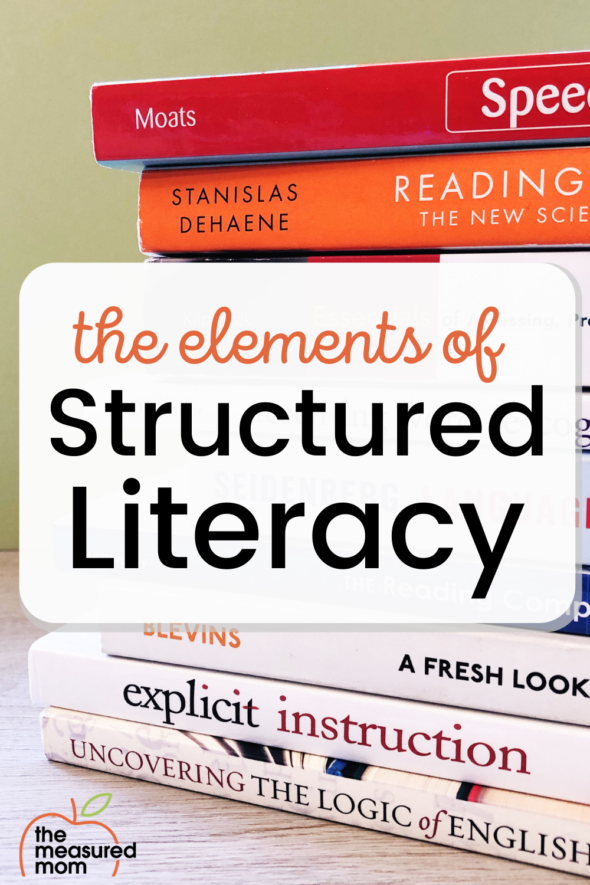
For years I considered myself a balanced literacy instructor.
And it'south not really a surprise. I was in college whencounterbalanced literacy came into existence (1996).
I entered the classroom during its heyday (1999).
And all the coursework I did for my master's degree in Curriculum & Instruction (with a focus on reading) revolved around a balanced literacy approach.
So why am I here talking about structured literacy?
I couldn't ignore it anymore.
I wanted to, believe me. I was sure that structured literacy meant drill-and-kill, phonics just, cringeworthy decodable books, and wearisome scripted curricula.
Everything I'd spoken against.
Simply guess what?
Turns out I was incorrect.
What is structured literacy?
Structured literacy was a term coined in 2022 by the International Dyslexia Association.
"The term 'Structured Literacy' is not designed to replace Orton Gillingham, Multi-Sensory or other terms in mutual use. It is an umbrella term designed to depict all of the programs that teach reading in essentially the same mode."
Hal Malchow, International Dyslexia Clan
Structured literacy uses explicit, systematic teaching to teach the post-obit elements:
- phonology
- sound-symbol
- syllables
- morphology
- syntax
- semantics
What are those? We'll get to that in a minute. But first …
Why exercise we need structured literacy?
For years, I was convinced that structured literacy was overkill.
After all, my students had thrived with a balanced literacy approach (I thought).
My oldest five kids learned to read using a balanced literacy approach (I taught them to read before they started schoolhouse).
What really opened my eyes was learning that while balanced literacy may be successful for some, it doesn't piece of work with anybody.
When I learned that nearly 40% of kids tin larn to read no matter how you teach them, merely that a greater per centum demand a structured literacy approach, things started making sense.
That student I had that couldn't read past level A no thing what I tried? She needed explicit phonemic sensation and so she could sound out words.
That trivial boy I taught who listened with rapt attention to my read alouds simply struggled to get words off the page? He needed systematic phonics with engaging decodable text.
That towering 16-yr-erstwhile football game player that I tutored during grad school? The one reading at a second form level? He didn't demand what my co-teacher and I were giving him … a smattering of this and a smattering of that. He needed someone to teach him the code.
Have you seen the ladder of reading?
Nancy Young, an experienced educator and speaker with extensive knowledge of show-based approaches to teaching reading, did her research and constitute that many students demand a structured approach to be successful readers.
As in, sixty% of students.

Equally I (oh then reluctantly) learned more, I found that structured literacy does not need to hateful boring.
It doesn't hateful that we kill the love of reading before it begins.
It means that we teach the essentials in a hands-on, engaging way.
What are the components of structured literacy?
Phonology
Phonology is the sound structure of spoken words. It refers to phonological and phonemic awareness. Phonological awareness includes the power to rhyme, count words in a sentence, and clap syllables.
Phonemic sensation is an important component of phonological awareness and involves the smallest parts of words: their individual sounds (phonemes). For instance, in the word fish we have four letters but just three phonemes: /f/ /i/ /sh/.
Sound-Symbol
The fancy explanation of "audio-symbol" is mapping phonemes to graphemes.
If you're looking for plain English, sound-symbol has to exercise with knowing what sounds go with which letters. For case, b is used to represent /b/. A more complex example is that igh is used to represent /i/.
(In other words … phonics.)
Audio-symbol is important for both decoding and encoding. Plainly English? Reading (decoding) and spelling (encoding).
Syllables
Have you heard of the six syllable types?
- open syllable
- closed syllable
- silent-e syllable
- r-controlled vowel syllable
- consonant-le syllable
- vowel pair syllable
I'll exist honest … I did not teach syllable types when I taught beginning readers. This felt tiresome and way more they needed to know to exist successful readers.
Little did I know that learning the six syllable types goes a long manner in helping children read long, unfamiliar words.
Morphology
Enough with the big words already, right?
A morpheme is the smallest unit of meaning in a language. Morphemes include roots, base words, prefixes, and suffixes.
Believe it or not, nosotros teach morphology in kindergarten. (When y'all teach kids that adding s to a word makes it "more than i" y'all're didactics morphology.)
Of course, it gets more than complicated every bit children movement through the grades.
Syntax
Syntax has to do with the mode we construction language to convey pregnant. Syntax is all about grammar and sentence structure.
Semantics
Semantics has to do with meaning. When nosotros teach semantics, nosotros teach comprehension of written linguistic communication.
What does structured literacy look similar in the classroom?
Peachy question!
I'm all virtually getting practical, and I won't leave you hanging.
Today'southward post was just a quick overview.
In the side by side calendar month, Becky Spence (This Reading Mama) and I are going to get specific.
Stay tuned for the rest of our seven-part series!
Desire to share?
Part 1 Part two Part three Role 4 Part 5 Part vi Role 7
Recommended reading
- Effective literacy pedagogy (International Dyslexia Association)
- Structured literacy educational activity: The nuts (Reading Rockets)
Source: https://www.themeasuredmom.com/what-is-independent-reading/
0 Response to "What is structured literacy?"
Post a Comment