Whats It Called When Water Evaporates Into Clouds Then Cycles Through Again

The water cycle, besides known every bit the hydrologic cycle or the hydrological cycle, is a biogeochemical bicycle that describes the continuous motility of water on, to a higher place and below the surface of the Globe. The mass of h2o on Globe remains fairly constant over time just the partitioning of the water into the major reservoirs of ice, fresh water, saline water (salt water) and atmospheric water is variable depending on a wide range of climatic variables. The water moves from i reservoir to another, such every bit from river to ocean, or from the sea to the atmosphere, by the physical processes of evaporation, condensation, precipitation, infiltration, surface runoff, and subsurface menstruum. In doing then, the water goes through different forms: liquid, solid (ice) and vapor.
The water cycle involves the exchange of energy, which leads to temperature changes. When water evaporates, it takes up energy from its surroundings and cools the surroundings. When information technology condenses, it releases energy and warms the environment. These heat exchanges influence climate.
The evaporative phase of the cycle purifies water which then replenishes the land with freshwater. The flow of liquid water and ice transports minerals across the globe. Information technology is also involved in reshaping the geological features of the Earth, through processes including erosion and sedimentation. The water cycle is also essential for the maintenance of nearly life and ecosystems on the planet.
Clarification
The sun, which drives the water cycle, heats water in the sea and seas. Water evaporates equally water vapor into the air. Some ice and snowfall sublimates directly into water vapor. Evapotranspiration is water transpired from plants and evaporated from the soil. The water molecule H
2 O has smaller molecular mass than the major components of the atmosphere, nitrogen (Northward
2 ) and oxygen (O
ii ) and hence is less dense. Due to the meaning difference in density, buoyancy drives humid air higher. As altitude increases, air force per unit area decreases and the temperature drops (come across Gas laws). The lower temperature causes h2o vapor to condense into tiny liquid water droplets which are heavier than the air, and which fall unless supported past an updraft. A huge concentration of these droplets over a large area in the atmosphere become visible as cloud, while condensation nigh footing level is referred to as fog.
Atmospheric circulation moves water vapor effectually the globe; cloud particles collide, grow, and autumn out of the upper atmospheric layers as precipitation. Some precipitation falls every bit snow, hail, or sleet, and tin accrue in water ice caps and glaciers, which tin can store frozen h2o for thousands of years. Well-nigh water falls as rain back into the bounding main or onto land, where the water flows over the ground equally surface runoff. A portion of this runoff enters rivers, with streamflow moving water towards the oceans. Runoff and water emerging from the ground (groundwater) may be stored as freshwater in lakes. Non all runoff flows into rivers; much of it soaks into the ground as infiltration. Some water infiltrates deep into the footing and replenishes aquifers, which tin can store freshwater for long periods of time. Some infiltration stays close to the state surface and can seep back into surface-water bodies (and the body of water) as groundwater discharge. Some groundwater finds openings in the land surface and emerges equally freshwater springs. In river valleys and floodplains, at that place is ofttimes continuous water commutation between surface h2o and ground water in the hyporheic zone. Over fourth dimension, the water returns to the body of water, to go along the water bicycle.
-
As the Earth's surface water evaporates, wind moves water in the air from the sea to the land, increasing the amount of freshwater on country.
-
Water vapor is converted to clouds that bring fresh h2o to country in the form of rain snow and sleet
-
Precipitation falls on the footing, but what happens to that water depends greatly on the geography of the land at whatever particular place.
Deep h2o recycling
The deep water cycle (likewise called the geological water cycle) is the substitution of h2o with the Earth'south mantle, via subduction zones and volcanic action, and is distinguished from the cycling of h2o above and on the surface of the planet in the Hydrologic Bike.[2]
The process of deep h2o recycling involves water entering the curtain by being carried down by subducting oceanic plates (a process known every bit regassing) being balanced past water being released at mid-ocean ridges (degassing).[2] This is a central concept in the agreement of the long‐term substitution of h2o between the world's interior and the exosphere and the transport of water bound in hydrous minerals.[3]
An imbalance in deep water recycling has been proposed as ane machinery that can bear upon global ocean levels.[ii]
Processes

Processes leading to movements and phase changes in water
- Precipitation
- Condensed water vapor that falls to the Earth'south surface. Virtually precipitation occurs equally pelting, but also includes snow, hail, fog drip, graupel, and sleet.[4] Approximately 505,000 km3 (121,000 cu mi) of water falls as precipitation each yr, 398,000 km3 (95,000 cu mi) of it over the oceans.[5] [vi] The rain on land contains 107,000 kmthree (26,000 cu mi) of water per year and a snowing only one,000 kmiii (240 cu mi).[6] 78% of global precipitation occurs over the sea.[vii]
- Subduction & Mineral hydration
- Body of water water seeps into the oceanic lithosphere through fractures and pores, and reacts with minerals in the crust and mantle to class hydrous minerals (such as serpentine) that store h2o in their crystal structures.[8] Water is transported into the deep mantle via hydrous minerals in subducting slabs. During subduction, a series of minerals in these slabs such every bit serpentine … can be stable at unlike pressures within the slab geotherms, and may send significant corporeality of water into the Earth's interior.[9] As plates sink and heat up, released fluids can trigger seismicity and induce melting within the subducted plate and in the overlying drape wedge. This type of melting selectively concentrates volatiles and transports them into the overlying plate. If an eruption occurs, the cycle then returns the volatiles into the oceans and atmosphere[10]
- Canopy interception
- The precipitation that is intercepted by establish leafage somewhen evaporates dorsum to the atmosphere rather than falling to the ground.
- Snowfall cook
- The runoff produced past melting snow.
- Runoff
- The variety of means past which h2o moves beyond the country. This includes both surface runoff and channel runoff. As information technology flows, the h2o may seep into the basis, evaporate into the air, become stored in lakes or reservoirs, or be extracted for agronomical or other human uses.
- Infiltration
- The period of h2o from the ground surface into the ground. In one case infiltrated, the water becomes soil moisture or groundwater.[11] A recent global study using water stable isotopes, however, shows that not all soil moisture is equally bachelor for groundwater recharge or for plant transpiration.[12]
- Subsurface menstruation
- The flow of water underground, in the vadose zone and aquifers. Subsurface water may return to the surface (e.g. as a spring or past being pumped) or eventually seep into the oceans. H2o returns to the land surface at lower meridian than where information technology infiltrated, under the force of gravity or gravity induced pressures. Groundwater tends to move slowly and is replenished slowly, and then information technology can remain in aquifers for thousands of years.
- Evaporation
- The transformation of water from liquid to gas phases as information technology moves from the ground or bodies of water into the overlying temper.[xiii] The source of energy for evaporation is primarily solar radiation. Evaporation frequently implicitly includes transpiration from plants, though together they are specifically referred to as evapotranspiration. Total annual evapotranspiration amounts to approximately 505,000 km3 (121,000 cu mi) of water, 434,000 km3 (104,000 cu mi) of which evaporates from the oceans.[5] 86% of global evaporation occurs over the bounding main.[seven]
- Sublimation
- The state modify directly from solid h2o (snow or water ice) to water vapor by passing the liquid state.[14]
- Deposition
- This refers to changing of water vapor directly to ice.
- Advection
- The movement of h2o through the temper.[15] Without advection, water that evaporated over the oceans could not precipitate over land.
- Condensation
- The transformation of water vapor to liquid water droplets in the air, creating clouds and fog.[xvi]
- Transpiration
- The release of water vapor from plants and soil into the air.
- Percolation
- Water flows vertically through the soil and rocks nether the influence of gravity.
- Plate tectonics
- Water enters the mantle via subduction of oceanic crust. Water returns to the surface via volcanism.
The h2o wheel involves many of these processes.
-
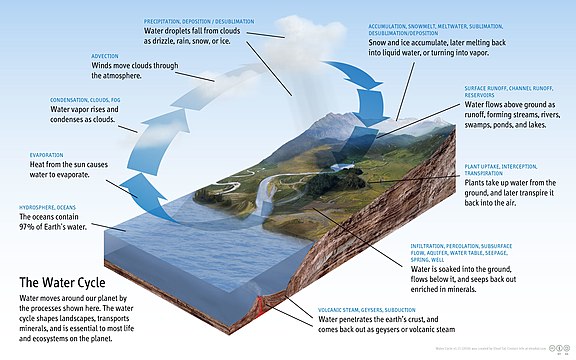
Diagram of the water cycle
-

Natural h2o cycle
Residence times
| Reservoir | Average residence fourth dimension |
|---|---|
| Antarctica | 20,000 years |
| Oceans | iii,200 years |
| Glaciers | 20 to 100 years |
| Seasonal snow cover | two to 6 months |
| Soil moisture | one to 2 months |
| Groundwater: shallow | 100 to 200 years |
| Groundwater: deep | x,000 years |
| Lakes (run across lake retentivity time) | 50 to 100 years |
| Rivers | 2 to half dozen months |
| Atmosphere | 9 days |
The residence time of a reservoir inside the hydrologic cycle is the boilerplate time a water molecule will spend in that reservoir (see side by side table). It is a measure out of the average age of the water in that reservoir.
Groundwater tin spend over 10,000 years beneath Earth's surface before leaving. Especially old groundwater is called fossil water. Water stored in the soil remains at that place very briefly, considering it is spread thinly beyond the World, and is readily lost past evaporation, transpiration, stream catamenia, or groundwater recharge. After evaporating, the residence time in the atmosphere is about 9 days before condensing and falling to the Globe as atmospheric precipitation.
The major ice sheets – Antarctica and Greenland – store ice for very long periods. Water ice from Antarctica has been reliably dated to 800,000 years earlier present, though the average residence time is shorter.[18]
In hydrology, residence times can be estimated in two ways.[ commendation needed ] The more than common method relies on the principle of conservation of mass (water balance) and assumes the amount of water in a given reservoir is roughly constant. With this method, residence times are estimated past dividing the volume of the reservoir past the rate by which water either enters or exits the reservoir. Conceptually, this is equivalent to timing how long it would take the reservoir to become filled from empty if no water were to leave (or how long information technology would take the reservoir to empty from full if no h2o were to enter).
An alternative method to estimate residence times, which is gaining in popularity for dating groundwater, is the employ of isotopic techniques. This is done in the subfield of isotope hydrology.
Changes over fourth dimension

Time-mean precipitation and evaporation as a part of latitude as simulated past an aqua-planet version of an atmospheric GCM (GFDL'southward AM2.i) with a homogeneous "slab-ocean" lower boundary (saturated surface with modest estrus capacity), forced by annual hateful insolation.

Global map of annual mean evaporation minus precipitation by breadth-longitude
| | This section needs to be updated. The reason given is: The IPCC and other related research effectually Climate change and the water cycle has had meaning updates, handled in the subpages.. (April 2022) |

The water wheel describes the processes that drive the motility of water throughout the hydrosphere. However, much more than water is "in storage" for long periods of time than is actually moving through the bike. The storehouses for the vast majority of all water on Earth are the oceans. It is estimated that of the 332,500,000 mi3 (1,386,000,000 km3) of the world's water supply, near 321,000,000 mi3 (1,338,000,000 km3) is stored in oceans, or nearly 97%. It is also estimated that the oceans supply near xc% of the evaporated water that goes into the h2o cycle.[xix]
During colder climatic periods, more than ice caps and glaciers form, and enough of the global water supply accumulates as ice to lessen the amounts in other parts of the water cycle. The opposite is true during warm periods. During the last ice age, glaciers covered near ane-3rd of Earth'due south land mass with the result existence that the oceans were about 122 1000 (400 ft) lower than today. During the last global "warm spell," about 125,000 years ago, the seas were virtually v.5 m (18 ft) college than they are now. About three 1000000 years agone the oceans could have been upward to l m (165 ft) higher.[xix]
Climate modify
The scientific consensus expressed in the 2007 Intergovernmental Panel on Climate change (IPCC) Summary for Policymakers is for the h2o cycle to continue to intensify throughout the 21st century, though this does non mean that precipitation will increase in all regions.[twenty] In subtropical land areas – places that are already relatively dry – precipitation is projected to subtract during the 21st century, increasing the probability of drought. The drying is projected to be strongest near the poleward margins of the subtropics (for example, the Mediterranean Basin, South Africa, southern Commonwealth of australia, and the Southwestern United States). Annual atmospheric precipitation amounts are expected to increment in near-equatorial regions that tend to exist moisture in the nowadays climate, and as well at high latitudes. These large-scale patterns are nowadays in nearly all of the climate model simulations conducted at several international inquiry centers as part of the quaternary Assessment of the IPCC. There is at present ample prove that increased hydrologic variability and change in climate has and volition continue to have a profound bear upon on the water sector through the hydrologic cycle, h2o availability, water need, and h2o allocation at the global, regional, basin, and local levels.[21] Enquiry published in 2012 in Scientific discipline based on surface ocean salinity over the flow 1950 to 2000 confirm this projection of an intensified global water cycle with salty areas becoming more saline and fresher areas becoming more fresh over the catamenia:[22]
Primal thermodynamics and climate models propose that dry regions will go drier and wet regions volition become wetter in response to warming. Efforts to detect this long-term response in sparse surface observations of rainfall and evaporation remain ambiguous. We show that ocean salinity patterns express an identifiable fingerprint of an intensifying water cycle. Our 50-year observed global surface salinity changes, combined with changes from global climate models, present robust bear witness of an intensified global water wheel at a rate of 8 ± v% per degree of surface warming. This rate is double the response projected by current-generation climate models and suggests that a substantial (16 to 24%) intensification of the global water cycle volition occur in a future 2° to 3° warmer world.[23]
An instrument carried by the SAC-D satellite Aquarius, launched in June, 2011, measured global sea surface salinity.[22] [24]
Glacial retreat is besides an example of a irresolute water cycle, where the supply of water to glaciers from precipitation cannot keep upwardly with the loss of water from melting and sublimation. Glacial retreat since 1850 has been extensive.[25]

Human activities
Human activities that alter the h2o bicycle include:
- agriculture
- industry
- alteration of the chemic composition of the atmosphere
- structure of dams
- deforestation and afforestation
- removal of groundwater from wells
- water abstraction from rivers
- urbanization - to counteract its impact, water-sensitive urban design can exist practiced
Furnishings on climate
The water cycle is powered from solar energy. 86% of the global evaporation occurs from the oceans, reducing their temperature by evaporative cooling.[26] Without the cooling, the effect of evaporation on the greenhouse upshot would atomic number 82 to a much higher surface temperature of 67 °C (153 °F), and a warmer planet.[27]
Aquifer drawdown or overdrafting and the pumping of fossil water increases the full amount of h2o in the hydrosphere, and has been postulated to be a correspondent to body of water-level rise.[28]
Furnishings on biogeochemical cycling
While the h2o cycle is itself a biogeochemical cycle, flow of water over and beneath the Earth is a key component of the cycling of other biogeochemicals.[29] Runoff is responsible for almost all of the ship of eroded sediment and phosphorus from country to waterbodies.[thirty] The salinity of the oceans is derived from erosion and send of dissolved salts from the country. Cultural eutrophication of lakes is primarily due to phosphorus, applied in excess to agricultural fields in fertilizers, and so transported overland and down rivers. Both runoff and groundwater period play pregnant roles in transporting nitrogen from the country to waterbodies.[31] The dead zone at the outlet of the Mississippi River is a consequence of nitrates from fertilizer beingness carried off agricultural fields and funnelled down the river organisation to the Gulf of Mexico. Runoff also plays a office in the carbon cycle, again through the transport of eroded rock and soil.[32]
Boring loss over geologic time
The hydrodynamic wind within the upper portion of a planet'south temper allows light chemical elements such as Hydrogen to move up to the exobase, the lower limit of the exosphere, where the gases can then attain escape velocity, inbound outer space without impacting other particles of gas. This type of gas loss from a planet into space is known as planetary wind.[33] Planets with hot lower atmospheres could effect in humid upper atmospheres that accelerate the loss of hydrogen.[34]
History of hydrologic cycle theory
Floating land mass
In ancient times, it was widely idea that the land mass floated on a body of water, and that nearly of the water in rivers has its origin under the world. Examples of this belief can exist found in the works of Homer (circa 800 BCE).
Hebrew Bible
In the ancient Nearly East, Hebrew scholars observed that even though the rivers ran into the sea, the body of water never became full. Some scholars conclude that the water cycle was described completely during this time in this passage: "The wind goeth toward the s, and turneth almost unto the northward; it whirleth about continually, and the wind returneth again according to its circuits. All the rivers run into the body of water, yet the bounding main is not full; unto the place from whence the rivers come, thither they return once again" (Ecclesiastes 1:6-seven).[35] Scholars are not in understanding as to the date of Ecclesiastes, though most scholars point to a date during the time of King Solomon, son of David and Bathsheba, "three one thousand years ago,[35] there is some agreement that the time period is 962–922 BCE.[36] Furthermore, information technology was also observed that when the clouds were full, they emptied rain on the earth (Ecclesiastes eleven:iii). In add-on, during 793–740 BCE a Hebrew prophet, Amos, stated that water comes from the sea and is poured out on the earth (Amos five:viii).[37]
In the Biblical Book of Job, dated between seventh and 2nd centuries BCE,[36] there is a description of precipitation in the hydrologic bike,[35] "For he maketh pocket-sized the drops of water: they pour down rain according to the vapour thereof; which the clouds practice drop and distil upon man abundantly" (Task 36:27-28).
Atmospheric precipitation and percolation
In the Adityahridayam (a devotional hymn to the Sunday God) of Ramayana, a Hindu epic dated to the fourth century BCE, information technology is mentioned in the 22nd poesy that the Sun heats upwards h2o and sends information technology downward as pelting. By roughly 500 BCE, Greek scholars were speculating that much of the h2o in rivers can be attributed to pelting. The origin of rain was as well known by then. These scholars maintained the belief, nevertheless, that water rising upwards through the earth contributed a not bad deal to rivers. Examples of this thinking included Anaximander (570 BCE) (who also speculated about the evolution of land animals from fish[38]) and Xenophanes of Colophon (530 BCE).[39] Chinese scholars such as Chi Ni Tzu (320 BCE) and Lu Shih Ch'un Ch'iu (239 BCE) had like thoughts.[twoscore] The idea that the water cycle is a closed wheel can be found in the works of Anaxagoras of Clazomenae (460 BCE) and Diogenes of Apollonia (460 BCE). Both Plato (390 BCE) and Aristotle (350 BCE) speculated nearly percolation as part of the water cycle. Aristotle correctly hypothesized that the dominicus played a office in the Earth's hydraulic cycle in his book Meteorology, writing "Past it [the lord's day'due south] bureau the finest and sweetest water is everyday carried up and is dissolved into vapor and rises to the upper regions, where it is condensed once more by the cold and so returns to the earth.", and believed that clouds were composed of cooled and condensed water vapor.[41] [42]
Precipitation lone
Up to the time of the Renaissance, information technology was thought that atmospheric precipitation alone was insufficient to feed rivers, for a complete h2o cycle, and that underground water pushing up from the oceans were the main contributors to river water. Bartholomew of England held this view (1240 CE), as did Leonardo da Vinci (1500 CE) and Athanasius Kircher (1644 CE).
The start published thinker to assert that rainfall alone was sufficient for the maintenance of rivers was Bernard Palissy (1580 CE), who is often credited every bit the "discoverer" of the modern theory of the water cycle. Palissy's theories were not tested scientifically until 1674, in a study commonly attributed to Pierre Perrault. Even and then, these behavior were not accepted in mainstream science until the early nineteenth century.[43]
Run into also
- Bioprecipitation
- Drought – Extended menses of deficiency in a region's h2o supply
- Ecohydrology
- Inundation – Natural disaster caused by water overflow
- Moisture advection
- Moisture recycling
- Planetary boundaries – Concept involving Earth system processes
- H2o utilise
- Deep h2o bike – Movement of water in the deep Globe
- Global meteoric water line
References
- ^ Abbott, Benjamin W.; Bishop, Kevin; Zarnetske, Jay P.; Minaudo, Camille; Chapin, F. Due south.; Krause, Stefan; Hannah, David M.; Conner, Lafe; Ellison, David; Godsey, Sarah E.; Plont, Stephen; Marçais, Jean; Kolbe, Tamara; Huebner, Amanda; Frei, Rebecca J.; Hampton, Tyler; Gu, Sen; Buhman, Madeline; Sara Sayedi, Sayedeh; Ursache, Ovidiu; Chapin, Melissa; Henderson, Kathryn D.; Pinay, Gilles (July 2019). "Human domination of the global water cycle absent from depictions and perceptions" (PDF). Nature Geoscience. 12 (7): 533–540. Bibcode:2019NatGe..12..533A. doi:ten.1038/s41561-019-0374-y. S2CID 195214876.
- ^ a b c Rüpke, Lars; Phipps Morgan, Jason; Eaby Dixon, Jacqueline (2013-03-19), Jacobsen, Steven D.; Van Der Lee, Suzan (eds.), "Implications of Subduction Rehydration for Earth's Deep Water Bicycle", Geophysical Monograph Series, Washington, D. C.: American Geophysical Union, pp. 263–276, doi:10.1029/168gm20, ISBN978-one-118-66648-7 , retrieved 2021-10-21
- ^ Magni, Valentina; Bouilhol, Pierre; Hunen, Jeroen van (2014). "Deep water recycling through time". Geochemistry, Geophysics, Geosystems. 15 (eleven): 4203–4216. Bibcode:2014GGG....15.4203M. doi:10.1002/2014GC005525. ISSN 1525-2027. PMC4548132. PMID 26321881.
- ^ "precipitation". National Snow and Water ice Data Center. Archived from the original on 2018-01-16. Retrieved 2018-01-fifteen .
- ^ a b "The H2o Cycle". Dr. Fine art's Guide to Planet Globe. Archived from the original on 2011-12-26. Retrieved 2006-x-24 .
{{cite web}}: CS1 maint: unfit URL (link) - ^ a b "Estimated Flows of Water in the Global H2o Cycle". www3.geosc.psu.edu. Archived from the original on 2017-11-07. Retrieved 2018-01-15 .
- ^ a b "Salinity | Science Mission Directorate". science.nasa.gov. Archived from the original on 2018-01-xv. Retrieved 2018-01-15 .
- ^ Frost, Daniel J. (2006-12-31), Keppler, Hans; Smyth, Joseph R (eds.), "xi. The Stability of Hydrous Mantle Phases", Water in Nominally Anhydrous Minerals, Berlin, Boston: De Gruyter, pp. 243–272, doi:10.1515/9781501509476-015, ISBN978-1-5015-0947-6 , retrieved 2021-02-27
- ^ Ohtani, Eiji (2015-12-fifteen). "Hydrous minerals and the storage of water in the deep mantle". Chemic Geology. 418: 6–15. Bibcode:2015ChGeo.418....6O. doi:10.1016/j.chemgeo.2015.05.005. ISSN 0009-2541.
- ^ Goes, Saskia; Collier, Jenny; Blundy, Jon; Davidson, Jon; Harmon, Nick; Henstock, Tim; Kendall, J.; MacPherson, Colin; Rietbrock, Andreas; Rychert, Kate; Prytulak, Julie; Van Hunen, Jeroen; Wilkinson, Jamie; Wilson, Marjorie (2019). "Projection VoiLA: Volatile Recycling in the Lesser Antilles". Eos. 100. doi:10.1029/2019eo117309. hdl:10044/i/69387. S2CID 134704781. Retrieved 2021-02-27 .
- ^ "Hydrologic Bicycle". Northwest River Forecast Heart. NOAA. Archived from the original on 2006-04-27. Retrieved 2006-10-24 .
- ^ Evaristo, Jaivime; Jasechko, Scott; McDonnell, Jeffrey J. (September 2015). "Global separation of constitute transpiration from groundwater and streamflow". Nature. 525 (7567): 91–94. Bibcode:2015Natur.525...91E. doi:x.1038/nature14983. PMID 26333467. S2CID 4467297.
- ^ "evaporation". National Snow and Ice Information Center. Archived from the original on 2018-01-16. Retrieved 2018-01-15 .
- ^ "sublimation". National Snow and Water ice Data Center. Archived from the original on 2018-01-16. Retrieved 2018-01-15 .
- ^ "advection". National Snow and Ice Data Center. Archived from the original on 2018-01-16. Retrieved 2018-01-15 .
- ^ "condensation". National Snowfall and Ice Information Center. Archived from the original on 2018-01-16. Retrieved 2018-01-fifteen .
- ^ "Chapter 8: Introduction to the Hydrosphere". 8(b) the Hydrologic Bike. PhysicalGeography.net. Archived from the original on 2016-01-26. Retrieved 2006-x-24 .
- ^ Jouzel, J.; Masson-Delmotte, V.; Cattani, O.; Dreyfus, G.; Falourd, S.; Hoffmann, Thousand.; Minster, B.; Nouet, J.; Barnola, J. M.; Chappellaz, J.; Fischer, H.; Gallet, J. C.; Johnsen, South.; Leuenberger, Yard.; Loulergue, L.; Luethi, D.; Oerter, H.; Parrenin, F.; Raisbeck, 1000.; Raynaud, D.; Schilt, A.; Schwander, J.; Selmo, E.; Souchez, R.; Spahni, R.; Stauffer, B.; Steffensen, J. P.; Stenni, B.; Stocker, T. F.; Tison, J. L.; Werner, K.; Wolff, Due east. West. (10 Baronial 2007). "Orbital and Millennial Antarctic Climate Variability over the By 800,000 Years" (PDF). Science. 317 (5839): 793–796. Bibcode:2007Sci...317..793J. doi:10.1126/science.1141038. PMID 17615306. S2CID 30125808.
- ^ a b "The Water Cycle summary". USGS Water Science Schoolhouse. Archived from the original on 2018-01-sixteen. Retrieved 2018-01-15 .
- ^ Aisle, Richard; et al. (Feb 2007). "Climate Change 2007: The Physical Science Footing" (PDF). International Panel on Climate Modify. Archived from the original (PDF) on February 3, 2007.
- ^ Vahid, Alavian; Qaddumi, Halla Maher; Dickson, Eric; Diez, Sylvia Michele; Danilenko, Alexander 5.; Hirji, Rafik Fatehali; Puz, Gabrielle; Pizarro, Carolina; Jacobsen, Michael (November 1, 2009). "Water and climatic change : understanding the risks and making climate-smart investment decisions". Washington, DC: Earth Bank: i–174. Archived from the original on 2017-07-06.
- ^ a b Gillis, Justin (Apr 26, 2012). "Study Indicates a Greater Threat of Extreme Weather condition". The New York Times. Archived from the original on 2012-04-26. Retrieved 2012-04-27 .
- ^ Durack, P. J.; Wijffels, South. E.; Matear, R. J. (27 April 2012). "Bounding main Salinities Reveal Potent Global Water Wheel Intensification During 1950 to 2000". Science. 336 (6080): 455–458. Bibcode:2012Sci...336..455D. doi:10.1126/science.1212222. PMID 22539717. S2CID 206536812.
- ^ Vinas, Maria-Jose (June six, 2013). "NASA's Aquarius Sees Salty Shifts". NASA. Archived from the original on 2017-05-16. Retrieved 2018-01-15 .
- ^ "Retreat of Glaciers in Glacier National Park". world wide web.usgs.gov. Archived from the original on 2018-01-04. Retrieved 2018-01-15 .
- ^ "Water Cycle | Scientific discipline Mission Directorate". science.nasa.gov. Archived from the original on 2018-01-15. Retrieved 2018-01-15 .
- ^ Life and Times of Dionysius the Divine: And His Forty Twelvemonth Journey in the Desert of Life. Xlibris Corporation. thirty Apr 2011. ISBN9781456875749.
- ^ "Rising bounding main levels attributed to global groundwater extraction". Academy of Utrecht. 2014-12-05. Archived from the original on May xi, 2011. Retrieved February 8, 2011.
- ^ "Biogeochemical Cycles". The Environmental Literacy Quango. Archived from the original on 2015-04-30. Retrieved 2006-10-24 .
- ^ "Phosphorus Bike". The Environmental Literacy Council. Archived from the original on 2016-08-20. Retrieved 2018-01-xv .
- ^ "Nitrogen and the Hydrologic Cycle". Extension Fact Sail. Ohio Country University. Archived from the original on 2006-09-01. Retrieved 2006-10-24 .
- ^ "The Carbon Bicycle". World Observatory. NASA. 2011-06-xvi. Archived from the original on 2006-09-28. Retrieved 2006-10-24 .
- ^ Nick Strobel (June 12, 2010). "Planetary Science". Archived from the original on September 17, 2010. Retrieved September 28, 2010.
- ^ Rudolf Dvořák (2007). Extrasolar Planets. Wiley-VCH. pp. 139–forty. ISBN978-3-527-40671-5 . Retrieved 2009-05-05 .
- ^ a b c Morris, Henry M. (1988). Scientific discipline and the Bible (Trinity Broadcasting Network ed.). Chicago, IL: Moody Press. p. 15.
- ^ a b Metzger, Bruce M.; Coogan, Michael D. (1993). The Oxford Companion to the Bible . New York, NY: Oxford University Press. pp. 369. ISBN978-0195046458.
- ^ Merrill, Eugene H.; Rooker, Mark F.; Grisanti, Michael A. (2011). The Earth and the Word. Nashville, TN: B&H Bookish. p. 430. ISBN 9780805440317.
- ^ Kazlev, Grand.Alan. "Palaeos: History of Evolution and Paleontology in scientific discipline, philosophy, religion, and popular culture : Pre 19th Century". Archived from the original on 2014-03-02.
- ^ James H. Lesher. "Xenophanes' Scepticism" (PDF). pp. nine–10. Archived from the original (PDF) on 2013-07-28. Retrieved 2014-02-26 .
- ^ The Basis of Civilization – water Scientific discipline?. International Association of Hydrological Science. 2004. ISBN9781901502572 – via Google Books.
- ^ Roscoe, Kelly (2015). Aristotle: The Male parent of Logic. Rosen Publishing Group. p. 70. ISBN9781499461275.
- ^ Precipitation: Theory, Measurement and Distributio. Cambridge University Press. 2006. p. seven. ISBN9781139460019.
- ^ James C.I. Dodge. Concepts of the hydrological Wheel. Ancient and modernistic (PDF). International Symposium OH
2 'Origins and History of Hydrology', Dijon, May ix–11, 2001. Archived (PDF) from the original on 2014-10-11. Retrieved 2014-02-26 .
Further reading
- Anderson, J. One thousand.; Wilmouth, D. M.; Smith, J. B.; Sayres, D. S. (17 Baronial 2012). "UV Dosage Levels in Summer: Increased Run a risk of Ozone Loss from Convectively Injected H2o Vapor". Science. 337 (6096): 835–839. Bibcode:2012Sci...337..835A. doi:10.1126/science.1222978. PMID 22837384. S2CID 206541782.
External links
- The H2o Wheel, Usa Geological Survey
- The Water Cycle for Kids, United States Geological Survey
- The water cycle, from Dr. Art'south Guide to the Planet.
- Water bike slideshow, 1 Mb Wink multilingual animation highlighting the ofttimes-overlooked evaporation from bare soil, from managingwholes.com.
- Will the moisture get wetter and the dry drier? – Climate research summary from NOAA Geophysical Fluid Dynamics Laboratory including text, graphics, and animations
Source: https://en.wikipedia.org/wiki/Water_cycle
0 Response to "Whats It Called When Water Evaporates Into Clouds Then Cycles Through Again"
Post a Comment